Wednesday, July 22, 2009

Wednesday, March 25, 2009
Last.fm Flips the Subscription Switch... In Smaller Markets — Digital Music News
Last.fm is finally spinning a subscription-based offering, at least outside of the US, UK, and Germany. In smaller markets, access to the custom-tailored, Last.fm radio service will soon cost 3 euros ($4.05) per month, according to the company. The rest is free, including recommendations, scrobbling, and networking, core components of the Last.fm model.
In the bigger markets, that same charge removes ads from the radio service, one that contains roughly seven million songs. Just like Pandora or Slacker, the Last.fm radio station fine-tunes over time, based on the tastes and preferences of the user. Sounds fun and engaging, though Last.fm disclosed that sales were simply not generating enough capital outside of its core markets.
Or, perhaps within the core markets. Increasingly, ad-supported, online media companies are struggling against bottom-scraping valuations, including YouTube. Whether Last.fm has better targeting remains unclear, though its concept is a bit more focused. Still, Last.fm has nothing near the traffic volumes of YouTube, and CBS appears to be struggling to properly monetize its $280 million investment. The changes go into effect March 30th.
Story by news analyst Alexandra Osorio.
Resnikoff's Parting Shot: Beyond Digital Pennies... — Digital Music News
There's good news for a media industry forced to trade analog dollars for digital pennies. According to Jeff Zucker, the NBC Universal chief who coined the famous conversion rate, digital pennies are now migrating towards dimes. "We're at digital dimes now, we're making progress," Zucker said last week during the McGraw-Hill Media Summit in New York.
Overly optimistic? The updated assessment appears rosy, at least according to back-of-the-envelope calculations. Zucker refused to discuss Hulu-related financial figures, though estimates peg annual revenues at $70 million. In 2008, NBC Universal revenues landed at roughly $17 billion, yielding a ratio (4/100) that beats a penny, but falls short of a dime. Whether that gap narrows over time remains unclear, though Zucker admitted that digital assets may never reach dollar-to-dollar replacement parity with analog.
Of course, Zucker is most concerned with the evolution of television, though his dollar-to-pennies comment resonates with related industries like music. But in music, specifically the recording industry, the ratios are quickly moving in the wrong direction. Paid downloads were once considered a high-growth category, though annual volumes seem to be plateauing. Other digital formats and concepts are struggling, and CDs are enduring a double-digit freefall.
The broader music industry - including touring, publishing, and licensing - is in better shape, and majors are wisely pursuing more diversified artist agreements. Still, labels are heavily rooted in recordings, and some are broadening better than others. Universal Music Group, for example, has been benefiting from aggressive acquisitions into publishing (BMG Music Publishing) and artist services (Sanctuary).
Perhaps Universal Music Group crosses the chasm, and successfully transforms itself into a different type of music company. But does a successful transition involve ditching attempts to monetize the recording? Instead of fighting a complete lack of scarcity, simply allowing the recording to move towards zero? Not a digital dime, not a penny, but simply nothing?
In reality, the transition happens with or without UMG - or EMI, Sony Music, or Warner Music. Sure, a download costs 99-cents on iTunes, but averaged against the immense volumes of file-traded music, the effective valuation is just above zero. Indeed, the disruption is already well underway, and labels are left weighing short-term, protectionist strategies against less-certain, longer-term bets. Either way, selling overpriced downloads against a backdrop of zero-scarcity is a difficult play.
So why the slow-footedness? A recent interview between an unnamed major label executive and TechCrunch suggests that the short-term could be a better strategic bet. Instead of rushing into a sea of digital pennies or worse, why not protect and prolong a dwindling pile of billions? That means litigating, restricting, and maximizing licensing fees on ill-fated companies like Spiralfrog, while worrying about the future later.
Perhaps that makes sense for an exiting executive, one whose strategic roadmap includes a golf course in 2012. But it makes little sense for the twenty- or thirty-something executive, and even less sense for artists attempting to build sustainable careers. That would explain why many artists are increasingly moving with market forces, and building their careers around moneymakers like touring, publishing, licensing, sponsorships, and other, cash-generating assets.
Or, simply rolling with what the market offers for the recording. Radiohead and Trent Reznor spring to mind, though artists across all tiers - developing, mid-range, and superstar - are crafting homegrown business models that make sense for them - and more importantly, the broader changes happening in music and media consumption.
...to be continued...
Paul Resnikoff, Publisher.
Tuesday, March 24, 2009
Monday, March 23, 2009
Thursday, March 19, 2009
Publishers cut book sharing deal with Scribd - Ars Technica
The online content-sharing site Scribd has reached an agreement with major publishing houses that will see it host free e-book content. Unlike their peers in the music business, the publishers are giving away content free in the hopes of drumming up business.
Digital Music Becomes (more) Rhizomatic: Evolutionary Traits of The Music�Industry - MTT - Music Think Tank
As digital audio files continue to flow freely on the Internet, music itself mimics certain inherent characteristics of the web best understood through Gilles Deleuze and Felix Guattari’s (D&G) rhizome metaphor. In A Thousand Plateaus, D&G introduce the concept of a "rhizome" to describe a representative model that extends in all directions and has multiple entryways; since then it has most commonly been used as a metaphor to represent the Internet. Understanding digital music as rhizomatic is important because it interprets the transformations of the digital music culture as a natural progression towards rhizomatic qualities – and provides us with an insight into what might be the future of “the music industry”. A few of the defining characteristics of the rhizome are connectivity, heterogeneity, multiplicity and cartography. Music can be understood as rhizomatic when its characteristics mimic those of the rhizome; thus music becomes more rhizomatic when those characteristics are amplified. According to D&G, any point of a rhizome “can and must be connected to anything other”. So we might think of anything that blocks connectivity as a contributing factor in making something less rhizomatic. Firewalls and 404-errors are just two examples of obstacles that fulfill this role. Digital music is also subject to a large set of infringing obstacles, some of which include DRM, other restrictions due to copyright laws, and pay-only access for downloads. As we see these barriers disappear, we also see digital music becoming more rhizomatic. While highlighting the defining characteristics of the rhizome...
I’ve suggested 5 examples illustrating how music has become more rhizomatic:
1) Music search engines Over the past few years we’ve seen music search engines like seeqpod and skreemr increase our level of connectivity to music. These sites crawl the web for music and provide links to the MP3s they find. Songza is a music search engine that goes as far as to search YouTube and strip out the audio tracks from uploaded videos. Music search engines look for data already present on the network and create new lines of access. If we think of the Internet as a large map, then by uploading music to the web we extend the map; and by using music search engines we create more connectivity. And because on the web music is “unbundled” from the album, we are free to connect directly to the music that interests us the most and ignore everything else.
2) Music Is Becoming Free The price of music continues to approach zero. This theory is supported by Michael Arrington in his post “The Inevitable March of Recorded Music Towards Free”, as well as by Seth Godin, British economist Will Page and myself on musicNeutral (to name a few). As music moves towards free, the pay-to-download price barrier is eroded, fostering greater connectivity between users and musicians.
3) The Persistence of File Sharing The persistence of file sharing spreads more music around the web, thereby extending the territory of the rhizome. According to D&G: “a rhizome may be broken, shattered at a given spot, but it will start up again on one of its old lines, or on new lines. You can never get rid of ants because they form an animal rhizome that can rebound time and again after most of it has been destroyed.” This trait is defined as “asignifying ruptures”, and it is exemplified in the persistence of music file-sharing sites. When one file-sharing site is shut down, two more turn up to replace it. The RIAA may have helped shut down popular music file sharing sites like Napster and Oink, but ultimately they can’t shut down P2P and BitTorrent technology. The characteristic of cartography is also present in the spread of music files online. We can draw a parallel of music "leaking" on the Internet to D&G’s depiction of the rhizome plant: “Go first to your old plant and watch carefully the watercourse made by the rain. By now the rain must have carried the seeds far away. Watch the crevices made by the runoff, and from them determine the direction of the flow. Then find the plant that is growing at the farthest point from your plant. All the devil's weed plants that are growing in between are yours.” The most recent example of this phenomena is with the new U2 album No Line On The Horizon: it was mistakenly available for download on the Universal Australia site two weeks before release and since has spread around the Internet (for example, here on the pirate bay).
4) Remix Culture D&G in their description of the rhizome state that “Music has always sent out lines of flight” and it is because of these “ruptures and proliferations “ that the musical form is “comparable to a weed, a rhizome”. The “lines of flight” may refer to the fact that a song can never be re-played exactly the same by a musician (e.g., no matter how minuscule, there will always be some variation in tempo or timbre), but in addition the lines of flight also encompass all of the derivatives. 'Remix culture' is closely associated with DJs that cut-up, rearrange and sample music tracks, but it also extends to the many derivative works sung by amateurs on sites like YouTube. Remix culture thus expresses the rhizomatic qualities of heterogeneity as well as multiplicity*.
5) Songbird The open-source music player Songbird allows you to browse the web for MP3s and download music to your local library. The remarkable thing about Songbird is the set of add-ons that instantly connect your music to relevant data called from around the web. Within the Songbird interface you can match upcoming concerts, lyrics, photos and reviews to the tracks you are listening to. Songbird’s add-ons facilitate direct connectivity and re-use of data that--in comparison--frames iTunes as a music prison.
In conclusion…the interesting thing about these five examples is that they’ve all emerged within only the past decade. Looking forward to the next ten years, musicians should embrace trends that support connectivity, heterogeneity and multiplicities if they want to stay ahead of the evolutionary curve of digital music, which in my opinion means supporting initiatives like Creative Commons and the free culture movement. Evidence has shown that digital music follows the path of least resistance – and ultimately it strives to be more like the rhizome.
*multiplicity includes not only the multiple, but also the variations of the original
-----------------------------------------------
Chris Castiglione is a New Media student in the graduate program at the University of Amsterdam. He holds a bachelor degree in Media Arts and Design from James Madison University. For his master's thesis Castiglione is researching the impact that Creative Commons has on musicians and the music industry. More information and writings can be found on the music blog musicNeutral or on his personal blog ccastig.com.i-and-e festival of improvised music ...
Friday 20 March
7 PM
JULIO CAMARENA (guitar)/ADAM LUBROTH (visuals)/WADE MATTHEWS (field
recordings,electronics)
SEYMOUR WRIGHT (solo alto saxophone)
FERGUS KELLY (homemade instruments)/JÜRGEN SIMPSON (electronics)
PASCAL BATTUS (homemade instruments) /CHRISTINE SEHNAOUI (alto saxophone)
Saturday 21 March
7 PM
SAFE (electronics)
LEO DUMONT (percussion)/CYRIL EPINAT (guitar)/MATHIAS FORGE (trombone)
ROBIN HAYWARD (solo tuba)
THOMAS LEHN (analogue synthesizer)/PAUL LOVENS (drums)
The Ireland Institute, 27 Pearse Street, Dublin 2 (next door to Trinity Capital
Hotel)
Admission 12 euro per concert or 20 euro for both nights (tickets at door)
The festival is staged with the support of the Arts Council of Ireland and in
partnership with the Goethe-Institut, Dublin and the Cervantes Institute,
Dublin.
http://i-and-e.digitalsook.net
musician links:
www.thomaslehn.de
www.robinhayward.de
www.seymourwright.com
www.myspace.com/
www.myspace.com/
http://pbattus.free.fr
www.dotdotdotmusic.com
Wednesday, March 18, 2009
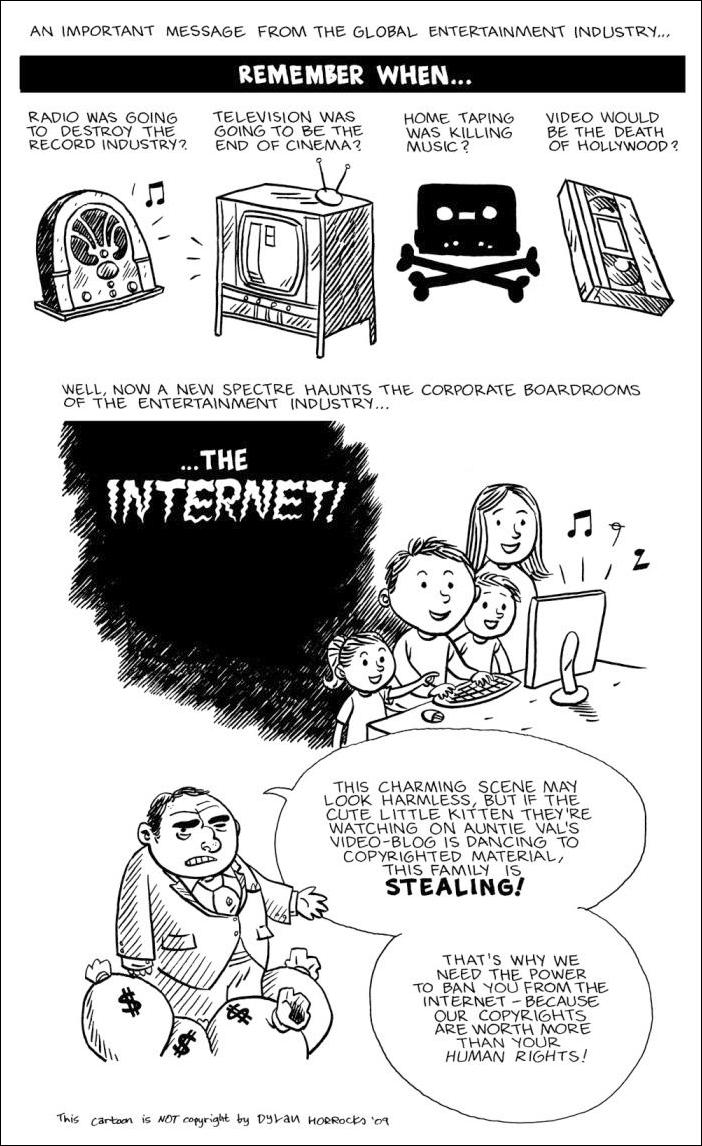
Friday, March 13, 2009
DRM Watch 2008: Year in Review, Part 1
DRM Watch 2008: Year in Review, Part 1
Extract:
Meanwhile, DRM for music has largely disappeared. Ironically enough, its last major redoubt is Apple's iTunes, which remains the predominant music retail site in the US and most other countries in which it operates. DRM is a requirement in the major record labels' licensing agreements with Apple (except EMI), and the majors have not relented on this requirement as they continue to seek viable competitors to iTunes. Amazon is the biggest of these but apparently has not made much impact on iTunes' market share.
Otherwise, the major music companies have been making licensing deals in which they progressively give away more content rights each time in search of traffic for ad revenue -- or, as Jonathan Zittrain of Harvard Law School has put it, they are attempting to profit from abundance instead of scarcity. It is now possible for MySpace users to stream music on demand for free (and for Google users in China to download it in MP3 for free). In the latest iterations of this process, Datz Music Lounge in the UK has an agreement with Warner Music and EMI to provide a year's worth of unlimited MP3 downloads for GBP 100 (US $147), and users of certain Nokia handsets get a year's worth of unlimited downloads bundled into the price of the device (see below).
Despite their protests to the contrary, we believe it's only a matter of time until the majors make a deal with some future source of huge Internet traffic to provide free MP3 downloads in exchange for an ad revenue share. Facebook is a leading suspect. We give this process until the end of 2010, at the latest, to run its course.
Is there a place for DRM anywhere in the music industry? For the moment, apart from iTunes, DRM is still used for Internet subscription services like Rhapsody and Napster. With MySpace (and others soon, to be sure), users can stream their choice of music at any time. Rhapsody and Napster offer "To Go" portable device transfer services that make them preferable, but those services, mostly based on Windows Media DRM, are somewhat clunky and will fall by the wayside as mobile broadband becomes more ubiquitous -- though by then, users will also be able to transfer their free MP3s to many types of portable devices.
The major music companies also hope to hang on to DRM for over-the-air mobile music. The landmark deal for mobile music this year has been Comes with Music, Nokia's arrangement with the majors (except EMI) to subsidize unlimited DRM-packaged music downloads for a year with certain Nokia handsets -- in other words, to get device makers instead of advertisers or users to pay for music. Comes with Music launched in the UK in October; its success remains to be seen.
The concern is that if the music industry hangs on to DRM for over-the-air music delivery, consumers will simply find ways of working around it (legal or otherwise), and therefore that the noose will tighten around mobile DRM for music as well. The mobile DRM market is still fragmented: Microsoft made a number of pre-announcements around PlayReady, its new mobile DRM, back in February. But not until this month did it announce an actual deployment for PlayReady, for BSkyB's Silverlight-based Sky Player TV service. There are plenty of mobile music services that use OMA DRM 1.0, and various other DRMs have small market shares.